Veterinary

Chiang Mai University's Mobile Vet Clinic - June 2021 Update: Part two

Since June was such a busy month for our veterinarians Dr. Khajohnpat Boonprasert and Dr. Siripat Khammersri and the CMU Mobile Vet Clinic team, our monthly report was split into two updates. We shared the first update in our July newsletter. And this month, we share more about their critical work to save elephants in Thailand.

CMU Mobile Vet Team on their way to Mae La Noi area

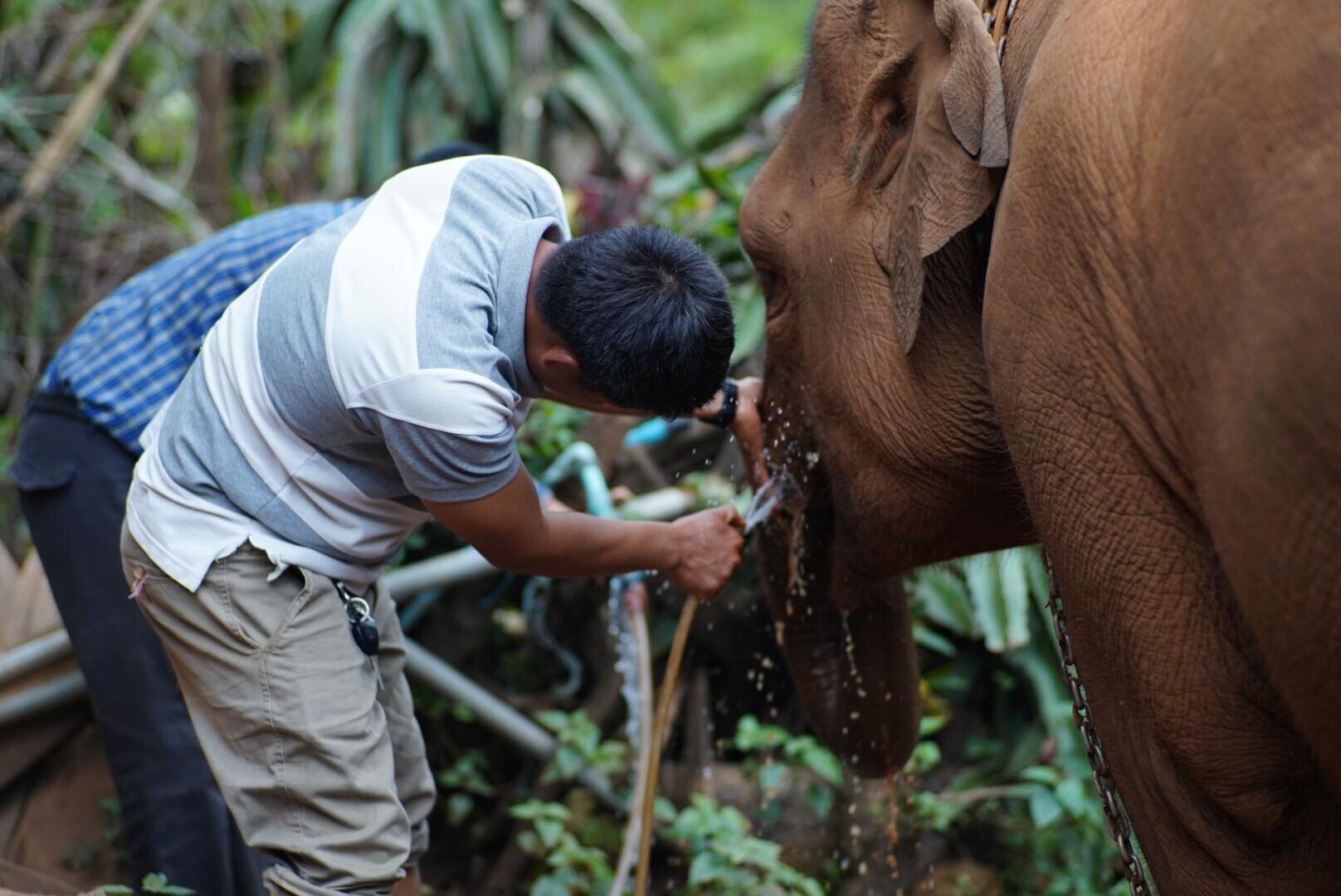
We left off with our doctors visiting the Mae Wang district of Thailand. Then, on June 16, they traveled to the Mae La Noi area, thanks to the coordination from the Thai Elephant Alliance Association (TEAA). The vets were called to provide life saving support to a 5 yearold elephant who was suffering from diarrhea and lethargy.


After taking a history, a physical exam was performed and medication started being administered. It was discovered that the young elephant’s diarrhea was being caused by ingesting soil, which can happen when there is a shift in the elephant’s environment or after a change of seasons. After some time observing the youngster, he started eating and the vets were confident the diarrhea had subsided. Before leaving the village the next day, June 17, the doctors checked on the elephant one more time and gave the elephant’s owner some medication to continue treatment if necessary.

Their next stop was Mae Tang district on June 21. The vets were called by an owner to examine his elephant’s eye with a cloudy cornea. During eye exams, the doctors use fluorescein stain in order to be able to spot corneal lesions. This elephant’s cornea was deemed clear of lesions or ulcers, but they did discover a minor irritation to the conjunctiva. The doctors used eye drops to relieve the irritation and also provided some advice to the elephant owner.


Finally, on June 21, an owner in the Mae Sariang area needed the assistance of the CMU Team and the TEAA to transport an older elephant to the Elephant Hospital at the Thai Elephant Conservation Center (TECC) in Lampang.

The elephant is suffering from chronic arthritis due to continuous weight shifting among her hindlimbs and forelimbs. The TEAA provided a transport vehicle and the older elephant was successfully transported to the Hospital the following morning, after quite a difficult night. We hope to follow the progress of this elephant’s health in our next report from the CMU Mobile Vet Clinic and keep you posted in our September newsletter if possible.


As always, you can visit www.asianelephantsupport.org to show your support for our tireless veterinarians who continue to travel across Thailand helping our treasured elephants by making a donation. Your donations and fundraiser support over the last year has kept the CMU Mobile Vet Clinic running and has helped save the lives of numerous elephants in need. We thank you for your continuing contributions.

Chiang Mai University's Mobile Vet Clinic - June 2021 Update

Doctors Khajohnpat and Siripat continued their diligent work for the elephants of Thailand in the month of June. Even as the COVID-19 pandemic continues to seriously affect the region and the travel conditions remain treacherous, our CMU veterinarians’ dedication remains strong.

June first had the doctors travelling to the area of Mae Wang. The doctors spent several days in that district tending to elephants with a variety of problems. June 2nd saw the veterinarians helping an elephant who wasn’t eating or drinking water, and had diarrhea which included dirt inside the feces. Treatments, which included activated charcoal and oral rehydration salt, began immediately. A few days later the elephant had fully recovered and was eating and acting normally.

Continuing in Mae Wang district, the team visited a camp with a mother elephant who was suffering from colic. At 4:00pm on June 4th, the vets started the mother on fluids and pain medications. They performed an enema, which revealed the elephant had dry, rough feces

Fecal samples showed signs of improvement after treatment

Mother receiving treatment, while calf stands under her head

After a day of treatment, the mother was still unable to pass feces on her own. The doctors continued to perform treatments, even with the mother’s calf by her side, and worked until 4:00pm on June 5th. To promote gastrointestinal activity and movement, the elephant was led by her mahout to the nearby river, and she finally passed the feces.

The next case in Mae Wang saw the veterinarians treating a young calf who had been bitten by a leech, and had been bleeding for six hours. After a call from the owner of the elephant, the veterinarians arrived at 8:00pm on June 9th and started treatments to stop the bleeding. Thankfully, the treatments were successful and the young elephant made a full recovery.


This was a busy month for the CMU Mobile Vet Clinic, so we will continue with more June updates in our next newsletter. In the meantime, visit the AES website to donate and support these essential efforts in providing critical care to our beloved Thailand elephants.

Chiang Mai University's Mobile Vet Clinic - May 2021 Update

Even through a new surge of COVID 19 in Thailand, our friends with the Chiang Mai University’s Mobile Vet Clinic, Drs. Khajohnpat and Siripat, continued their most important visits to elephants in need throughout Thailand.

The month of May was spent mainly in the Mae Tang district. Their first case on May 9 was to conduct a blood transfusion from 2 elephants for a third elephant who was suffering from anemia. The transfusion was successful and the elephant that accepted the transfusion began to respond to treatment and appears to be recovering.

(Left): Dr. Siripat with assistance from a Vet Nurse to collect blood from donor elephant

(Right) Elephant is receiving life-saving transfusion

On May 12 the doctors visited an elephant owner who was concerned about his elephant who was emaciated and had been losing weight over the course of a month. The veterinarians collected some secretions from the elephant’s trunk which tested positive for tuberculosis, a serious respiratory disease that affects humans and elephants. The doctors advised the elephant’s owner to monitor symptoms and to start planning for the very intense treatment for the disease. Unfortunately, 5 days later, the elephant passed away from the disease.

Critically ill elephant - while not all cases have happy endings, the veterinarians provide advise and care wherever needed

May 26, a national Thai holiday, found the doctors traveling to visit an elephant who was in abdominal distress. After examination, the veterinarians decided to administer fluids and pain relievers at about 2:30 in the afternoon. After this, they gave the elephant an enema and found dry, rough feces inside the elephant that was the probable cause of the distress. After inquiring with the owner further it was found that the elephant in question was stealing the other elephant’s hay overnight and consuming it.

The next day, the elephant still could not pass feces by herself. The doctors continued their fluids, pain relievers and enemas. Finally, by 8:00pm on May 27, the obstructive feces were pulled out and completely removed. The veterinarians suggested to the elephant owner that he begin chopping the grass he feeds to this elephant, and mixing it with water and supplements to prevent the consumption of dry food. They also suggest that the owner discontinue feeding older elephants hay, which can cause colic.

Although their job is not glamorous, and the endings are not always happy ones, the CMU Mobile Vet Clinic veterinarians and nurses continue their tireless work for the elephants of Thailand. To support their efforts, and efforts for elephants all across Asia, please visit our website www.asianelephantsupport.org to make a life saving donation.

Critically ill elephant - while not all cases have happy endings, the veterinarians provide advise and care wherever needed

Chiang Mai University's Mobile Vet Clinic - April 2021 Update

Dr. Siripat providing care to elephant during an annual visit

Dr. Khajohnpat and Dr. Siripat kept quite busy during the month of April in the Chiang Mai University’s Mobile Vet Clinic. The van, donated by AES in March 2019, has been taking the veterinarians across Thailand performing health checks and providing emergency medical care to elephants in need.

Dr. Khajohnpat advises owners on elephant care strategies

The doctors traveled to Huay Pak Kood, Mae Jam district from April 7-8, to make a visit to about 50 elephants they hadn’t seen in a year. They provided care to the elephants as well as spent time with mahouts and owners, discussing any issues they may have in order to keep their elephants healthy for the following year.


A tragic wind storm swept through the Mae Wang district on April 14, killing three elephants and leaving three injured from a fallen 100 year old tree. The veterinarians rushed to the area and helped treat the elephants in need.

Treating a severely injured elephant following the windstorm

Two injured elephants were transported to the Elephant Hospital at the Thai Elephant Conservation Center with the help of the Thai Elephant Alliance Association team of doctors. One injured elephant was not seriously hurt so she was treated and will be monitored further. After investigation of the area, it is believed the female elephants of the herd were surrounding a calf to protect him and keep him calm during the storm.

April 22 saw the CMU van travel to the Mae Tang district to help an elephant owner manage his bull elephant going into an early musth.

In Thai and English sig reads DANGER! NO Entry, Elephant in musth

Their plan of sedating the male, securing him and walking him into his containment area was a success. By using the best safety protocols, the veterinarians were able to safely secure the bull with no injuries to the elephant or people.

April ended with the doctors heading to the Pai area to treat an elephant that was suffering from abdominal distension and diarrhea. Fluid therapy for rehydration, supplements and pain relief were administered immediately. While treating this elephant, another elephant with the same owner was showing colic symptoms.

After conversing with the owner, the cause of the colic was discovered – dry vegetation. The veterinarians suggested to the owner that he mix chopped grasses with water and supplements. The veterinarians decided to treat the elephants with activated charcoal and fluids with supplements and their condition improved within a few days.

We continue to be so proud of Dr. Khajohnpat, Dr. Siripat and the entire CMU Mobile Vet Clinic team and their tireless work to help Asian elephants all over Thailand. And we couldn’t have made it this far without your support! Stay tuned to future newsletters for continued updates and stories of their journeys. As always, please visit www.asianelephantsupport.org to make a donation to help keep our veterinarians going strong!

Dr. Siripat with patient eating soaked food

March 2021 Update - CMU Mobile Vet Clinic

After a monumentally successful fundraiser - thanks to you, AES's amazing community of supporters - and being able to fully fund the salary for a second veterinarian, February and March saw the doctors with Chiang Mai University’s Center of Elephant and Wildlife Research Mobile Veterinary Clinic continuing their mission of providing veterinary care to Asian elephants all over Thailand. Using the AES donated van, the tireless veterinarians were able to traverse all sorts of terrain, including crossing a waterway to reach a remote forest village (Facebook users: click here to see the CMU van in action).

Their travels took them to the western border with Myanmar, and with the help of the Thai Elephant Alliance Association (TEAA), led by President Therrapat Trungprakan, the CMU van took a 6 hour drive, for the third time in a month, to help a 9 year old female elephant suffering from mouth burns. The elephant was roaming loosely, around a farm at night, away from her owner, and got into some bottles of farming chemicals. As elephants do, the elephant put those chemicals in her mouth, causing chemical burns. Thankfully the elephant, with guidance and help from the veterinarians, the TEAA team and the dedication of her owners and caretakers, was able to fully recover.

Photo courtesy of TEAA: A touching photo of an elephant owner, grateful for the care provided by the CMU Mobile Vet Clinic

Specifically travelling to the districts of Om Koi, Mae La Mad and Ta Song Yang, Drs. Siripat and Khajohnpat, along with the CMU Elephant and Wildlife Research team, provided education to local elephant owners and villagers on the importance of wild elephants living in their natural forests. Up until this point, these areas did not have any issues with human-elephant conflict, however there are now conflicts among elephant owners and farmers where elephants are getting into local corn farmers’ plantations. The veterinarians also discussed elephant management, disease and ways to medically treat elephants. While in these remote areas educating, the doctors also visited and treated several sick elephants.

Dr. Siripat and the team with the CMU Mobile Vet Clinic providing essential education and tools to owners and caretakers

AES couldn’t be more proud to see the elephant success stories and the education Dr. Khajohnpat and Dr. Siripat are providing communities across Thailand.

Thank You for Making the Chang Vet Aid 2021 Fundraiser a Success!

Plai Salawin stands next to the CMU Van - Hundreds of elephants are helped by the clinic every year, thanks to your support

We at Asian Elephant Support, count ourselves lucky to have such amazing friends, who love and care for Asian elephants and their caretakers as much as we do!

From Canada to New Mexico, from New York to Santa Barbara, and everywhere in between, you supported the Chang Vet Aid 2021 fundraiser and our efforts to provide the salary for Dr. Siripat, the additional Veterinarian with Thailand's Chiang Mai University Mobile Vet Clinic. 

On behalf of all of us at Asian Elephant Support, thank you for making this fundraiser such an overwhelming success. With your help we raised more than $15,000 through shirt sales and additional donations during the campaign, allowing us to not only provide the salary for the second Veterinarian but also to continue to fund emergency requests for aid throughout Asia during this difficult time. 

We hope that all those who purchased items enjoy and wear them with pride when they arrive in the mail and that all those who contributed know how grateful we are to you for your generosity. 

Linda, Barbara, Liz & Mindy

Asian Elephant Support, Board of Directors

Thanks from TEAA for CMU Mobile Vet Clinic

The week of February 24th the Chiang Mai University (CMU) Mobile Vet Clinic in partnership with the Thai Elephant Association Alliance (TEAA) responded to an emergency involving an elephant that had sustained injuries from drinking herbicide.

Welcome Dr. Siripat - New Veterinarian for CMU Mobile Vet Clinic

Dr. Siripat Khammesri with the Chiang Mai University Mobile Vet Clinic

With support from AES, our dear friend, Dr. Khajohnpat Boonprasert from the Chiang Mai University Mobile Vet Clinic, has teamed up with a second veterinarian, Dr. Siripat Khammesri. The two will both be traveling, providing veterinary care and health checks to Thailand’s elephants.

The addition of a second veterinarian is critical, especially during the pandemic that has left many elephants out of work due to the lack of tourists.  Owners have taken their elephants back to their home villages and the mobile clinic is spending much more time on the road to care for these elephants. 

One of their recent stops was to Surin Province, located in south eastern Thailand. There, the doctors collaborated with the Institute of Elephant Research and Healthcare services, livestock department and with the Thai Elephant Conservation Center.  While on this mission, the doctors treated a remarkable 65 elephants!

Elephant from Surin Province surveys CMU Van’s trunk space

Veterinarians and Mahouts performing blood draw

In the photos from Surin province, you can see the doctors helping the local men and women perform blood draws from the elephants’ ears, which helps in determining an elephant’s overall health.

On the way home to Chiang Mai, they stopped at a Buddhist festival in Uthai Thani province to provide healthcare services for three elephants there.  Treatments included NSAIDs for lameness and eye care medications.   

Looking ahead, the two veterinarians will be able to travel to an extended area in northern Thailand, and be able to cover for each other for emergencies, on weekends and holidays.

With the use of the transport vehicle, both doctors will be able to serve Thailand’s elephants more effectively.  We are proud to watch the vehicle AES donated to the CMU Mobile Vet Clinic be used, both effectively and efficiently.  We hope you will follow along with us while we watch the impact of the mobile unit grow. AES thanks our donors who make such efforts happen. Thank you!

Med Care Boxes in Thailand

In March, tourism came to a screeching halt in Thailand due to the restrictions imposed by the COVID-19 pandemic. This in turn resulted in the tourist camps closing and the mahout owners returning with their elephants back to their home regions, and in many cases to very remote areas.


Almost immediately a partnership was formed by the Thai Elephant Alliance Association and the Center for Elephant and Wildlife Research to provide medical care to all elephants including those that were no longer in areas or camps with veterinarians.
 
AES provided funding to both the TEAA and the CEWR to help with the additional visits, medicines and supplies that would be needed to help in this crisis. Part of that help was to provide first aid emergency med care boxes to elephant owners so that they could perform some health care themselves. TEAA provided food supplies for the elephants.
 
Throughout this time a total of 72 kits to help over 1200 elephants across Thailand have been distributed: some for communities where they do have some veterinary practitioners but most for camps and owners without veterinarians. And what do these big blue boxes contain to help Asian elephants? Wound dressing kits, pain killers, gastrointestinal drugs, ophthalmic drugs, vitamins, antibiotic injections, NSAIDS injections, among other medicines.

Thai CMU Mobile Vet Van Report

Dr. Khajohnpat Boonprasert, Center of Elephant and Wildlife Research, Chiang Mai University

If you have been following AES via Facebook and reading previous newsletters you will know that the CMU Mobile Vet Van that AES donated last year to the Center of Elephant and Wildlife Research has been extremely busy during the covid pandemic. In partnership with the Thai Elephant Alliance Association they have been able to help many camp owners and mahouts take care of their elephants when they would not have otherwise been able to afford veterinary care due to loss of tourism income.  

Since March 2019 the CMU Mobile Vet Van has traveled about 58,430 km (36,306 miles) with 5,000 km (3,106 miles) of that during the covid-19 pandemic. That is a lot of trips and many elephants that have been helped thanks to the donations made to AES to provide the van as well as provide medical supplies during the crisis.

This month Dr. Khajohnpat Boonprasert of the Center of Elephant and Wildlife Research, Chiang Mai University has reported back about 2 of their recent trips.

“Friday July 3: CMU and TEAA staffs went to Mae Jame district for an urgent emergency case. A new born calf had gotten wound in abdominal and its intestines pulled out. We took 4 hours to arrive at the closest village to the calf. Unluckily, the calf died 2 hours before we arrived. Although, we could not save the baby’s life, we provided health care services for the other elephants there, such as a broken tusk case.”


“Monday July 6: Gastrointestinal distress/constipation in Asian elephants
A 45-year-old pregnant female elephant (Pang Tang-Mo) had suffered from GI discomfort in the middle of the night due to GI constipation. She could not pass her stool out normally and gasses in the intestine were continually built-up causing a lot of pain. The mahout team looked after her closely throughout the night. Our team provided intensive treatment with a painkiller, IV fluids, GI stimulants, encouraged movement, and performed rectal enema. She responded to the treatment very well and recovered the following day.

“This problem can be caused by various factors which including improper diet, inappropriate water consumption, low physical activities of elephants, etc. GI constipation/colic can even contribute to the life-threatening to the elephants in some severe cases. So the proper management whether elephant diets or encourage physical activities is very important especially during the COVID-19 pandemic which the activities of the elephant had been changed due to less tourist visiting.”
#ElephantHealthOurHeart

Assisting CEWR and TEAA during COVID-19 pandemic

AES is assisting the Center of Elephant and Wildlife Research and the Thailand Elephant Alliance Association in helping elephant owners and camps to provide medical care to their elephants during their  loss of revenue due to covid shutdown of tourism. The recent funds that AES has provided were used to provide free of charge medicine for the CMU mobile elephant clinic (that AES provided last year). The funds were also used to provide 30 First aid med-boxes for elephant and camp owners to treat elephants.

Shown below are some of the blue  First aid med-boxes for the owners to treat their elephants. These photos were taken on a recent trip by the CMU mobile vet van to villages in Mae Jam district to help 100 camp elephants.

CMU Van Working During Covid-19

Dr. Yeaw of the Center of Elephant and Wildlife Research has reported that during the covid-19 outbreak, they have also corroborated with the Thai Elephant Alliance Association for helping elephants that need urgent veterinary services using the CMU Mobile Vet van that AES donated in 2019.

They recently treated an elephant that had been lame and non-weight bearing for many days. During the exam they found a chronic abscess and inflammation. They then opened the abcess, dressed the wound and applied anitibiotic.

Myanmar Vets' to Thailand

Asian Elephant Health and Breeding Management Course in Thailand: Report for Asian Elephant Support

In the online part of the course (22 April to 24 May 2019), we learned about anatomy, physiology, nutrition, endocrinology, ultrasonography, anesthesia, restraint, and breeding and parturition management of Asian elephants.

In June we participated in a 5-day practical course in northern Thailand. The first day (10 June) we had lectures on health care management, endotheliotropic herpes virus, nutrition, plasma transfusion and blood cross match at Chiang Mai University in the Faculty of Veterinary Medicine.

The next days were practical training and demonstrations at the National Elephant Institute in Lampang, and Elephant Rehabilitation center, Pang Lah. On 11 June we had presentations on common health problems, tuberculosis, nutrition, and case studies in Sri Lanka and Thailand. From 12 to 14 June we studied rehabilitation, obesity, welfare, anesthesia, practiced using an elephant-like ultrasonography, semen collection, semen evaluation, estrus detection, reproductive hormone monitoring and calf management after parturition etc.

From this trip, we got the opportunity to hear a lot of elephant information and we got to share knowledge regarding elephant health care management from different regions. Therefore, your support is absolutely effective for us and for taking care of our elephants.

Finally, we would like to express our sincere thanks to Asian Elephant Support for your kind support for our trip. Without your support we could not benefit from this training.

Best regards,

Dr. Moe Win Tun
Dr. Zaw Min Htun

CMU Mobile Veterinary Van

The CMU Mobile Veterinary Van purchased with AES funds has been quite busy since its official inauguration this past March. Here are a few pictures of its progress in helping Asian elephants in Thailand (which, in turn, will extend to solving medical issues for elephants worldwide). Thanks to Dr. Yeaw for providing most of these photos.

You, our supporters, have made this all possible. Many thanks!

The van’s official inauguration at CMU on Thai Elephant Day

Van being blessed by a Buddhist monk

Examining and prescribing treatment at a remote camp

Collecting research data

EREC Bonfire T-shirt Campaign

Benefitting the EREC New Mobile Vet Unit

We are excited to announce a new way to help us purchase a mobile vet truck for Chiang Mai University Vet Department to provide care for the surrounding area's elephants.

Dr. Yeaw performing a blood draw from the ear. Typically blood draws are performed from the ear, but they can also be done on the rear leg while the elephant is standing

Currently they are using one vehicle for 4 veterinarians to make house calls to local elephant camps.  AES would like to provide them with a second vehicle to be shared among the vets and to make sure they have a backup in case one breaks down.  The campaign is set to run for 10 days, from July 15th - July 25th.

We'd like to sell as many t-shirts as we can so please share this campaign with everyone you know and buy a couple shirts for yourself!  This is a special, one-of-a-kind shirt only available for this fundraiser.  It features our logo and the EREC logo in white on a charcoal grey shirt.

Thank you and we will keep everyone posted on the progress via our Facebook page!

https://www.bonfire.com/elephant-mobile-vet-unit-fundraiser

(Left) Dr. Yeaw performing an eye exam

(Right) Dr. Yeaw with a newly collected blood sample