
On November 29, a local veterinarian reported that an elderly elephant had collapsed and was unable to rise on its own. The veterinarian assisted the animal by supporting it with a chest strap secured to a tree and lifting efforts using an excavator, along with providing fluid therapy and vitamin supplementation. Upon follow-up examination on December 1, the elephant showed no signs of tremors, was able to walk, had normal defecation, and had a body temperature of 34.8°C (94.6°F). The elephant was eating and drinking normally and remained supported by the chest strap, with additional environmental warming provided by fire, sunlight exposure, and wind protection. Further vitamin support was administered, and blood samples were collected for health assessment. Laboratory results indicated rhabdomyolysis (muscle breakdown), and so the animal will continue to require monitoring and supportive care.
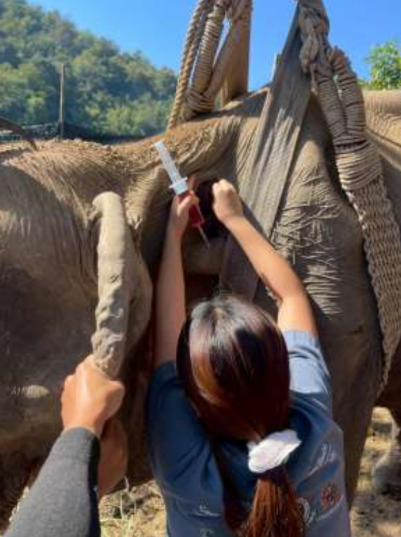
The veterinarian gives the elephant fluids while the elephant remains supported in a chest trap
On November 27, an owner reported that a 36-year-old female elephant was experiencing vulvar bleeding, described as passing blood clots without signs of depression, abdominal pain, or straining, and with no history of pregnancy. The following day the bleeding persisted but had decreased, so the veterinarian advised starting a 7-day course of supplements to support healthy blood production. Based on the symptoms mentioned, the veterinarian suspected that the cause of all the bleeding may be a mass inside the uterus, a leiomyoma. A follow-up examination on December 2nd revealed the elephant to be bright, alert, and with normal appetite and defecation, and no further vulvar bleeding. CBC and blood chemistry results showed no abnormalities, and the progesterone hormone level is low, suggesting that the elephant is not pregnant. The proposed treatment includes re-evaluating the elephant’s hormone levels in one month (January, 2026) to establish a baseline progesterone profile. Monthly administration of the GnRH vaccine will be continued until the vaginal bleeding subsides, although this approach may decrease her chances of becoming pregnant.
During the first week of December, it was reported to the CMU Mobile Vet team that a 60-year-old female elephant had slipped and fallen, resulting in right hindlimb lameness after her knee struck a fence post. On physical examination, the elephant showed dragging of the affected limb, was able to bear weight, and had no external wounds, swelling, or warm, but had avoided lying down at night since the incident. The veterinarian administered anti-inflammatory medication and performed laser therapy to reduce inflammation. The owner was advised to provide cold compresses on the injured area twice daily for 5–10 minutes each session, and to restrict the elephant’s movement to prevent further strain.
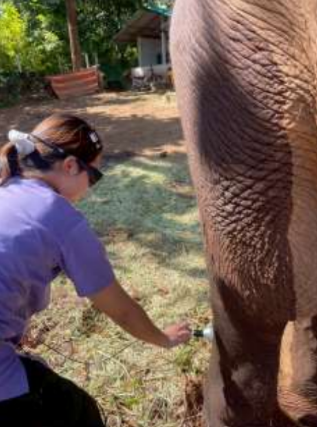
The veterinarian preformed laser therapy of the right hind limb
On December 25–26, the veterinary team from the Chiang Mai University Mobile Vet Clinic welcomed students and faculty members from Ohio, for a hands-on training workshop on the diagnosis of elephant diseases at the Thai Elephant Conservation Center, Hang Chat District, Lampang Province. The workshop provided comprehensive instruction on elephant behavior and fundamental health care, as well as diagnostic and therapeutic approaches to diseases in elephants. Furthermore, the program facilitated an academic exchange of knowledge and perspectives on elephant management and care practices between Western and Eastern cultures.
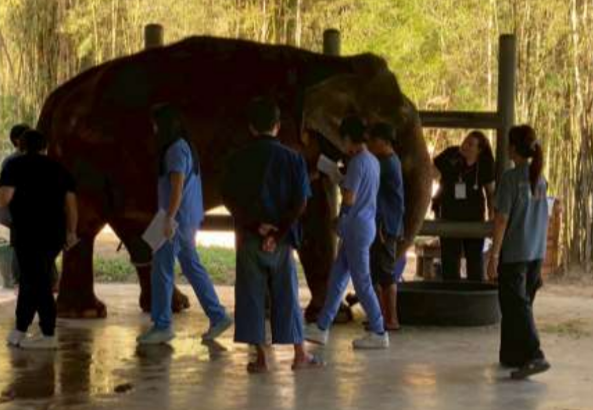
Veterinarians guide students in conducting physical examinations of elephants
The professionals of the Chiang Mai University Mobile Vet Clinic continue to provide top notch care for elephants in all states of health. We are so grateful for their efforts to provide care for Thai elephants of all ages! Donate today to support the care of Thai elephants.