
February was a very full month for the veterinary team with the Chiang Mai University's Mobile Vet Clinic. Interestingly a majority of the cases this month created some form of lameness for the patients being examined. These cases highlight for us just how important an elephants feet and joints are to their over quality of life.
On February 5th, a report was received regarding two elephants from two different elephant camps in Mae Tang District that had stepped on nails. The mahouts reported that the elephants had stepped on nails approximately one week prior. The nails, approximately two finger joints in length, were removed by the mahouts at that time. The wounds had been cleaned daily using normal saline solution and povidone-iodine. Upon further physical examination of the first elephant, sharp-object wounds were observed on both hind limbs. Purulent discharge was present, and the elephant exhibited signs of pain upon palpation of the affected areas. The veterinarian recommended cleaning all wounds, including the nail puncture wounds and the hind limb wounds, twice daily (morning and evening). In addition, tetanus vaccination was administered.
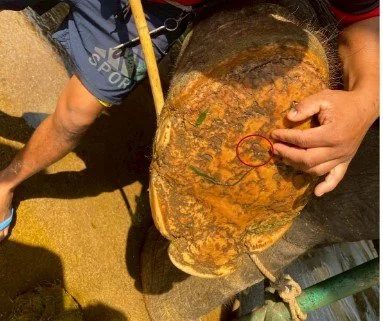
Nail puncture wound (red circle) featured on left hind foot
At the second camp, an abscess wound was identified above the first nail of the left hind limb characterized by swelling and increased warmth compared to surrounding tissues. The elephant exhibited pain upon palpation and was reluctant to allow wound cleaning. For safety during the procedure, the affected limb was restrained. Wound management was then initiated. The wound was scrubbed and irrigated with chlorhexidine, followed by hydrogen peroxide to facilitate drainage of purulent material, then normal saline solution, diluted povidone-iodine, drying of the wound, and a final application of povidone-iodine. Additionally, nail trimming was performed. The mahout was advised to clean the wound daily, keep the elephant on a concrete surface to reduce environmental contamination, and restrict walking to promote healing.
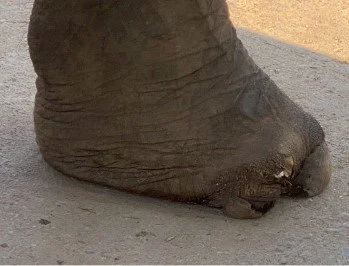
An abscess wound with purulent discharge and swelling was observed as a result of the hardware that was removed the previous work
On February 8th, the elephant owner reported that an elephant had sustained a leg injury after slipping and twisting the limb. Following the incident, swelling of the affected limb was observed, and the elephant showed reluctance to bear weight. The next day, when the veterinarian visited the site for case evaluation. Physical examination through palpation revealed mild swelling, tenderness, and slightly increased warmth at the affected area compared to surrounding tissues. Thermographic imaging showed no significant temperature difference between the injured limb and adjacent areas, suggesting the absence of severe tissue damage but an injury consistent with inflammation. The veterinarian administered an intramuscular anti-inflammatory injection and prescribed oral anti-inflammatory medication for continued treatment. Continued cold compresses and topical massage therapy were recommended as adjunctive management.
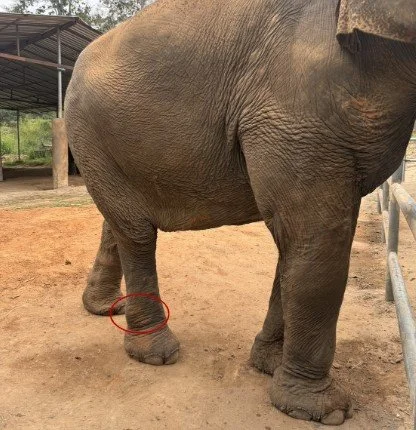
The right hind limb showed mild swelling; however, weight bearing remained good
A 55-year-old female elephant was reported mid-month to have developed a swelling on the left hind limb. The mahout was unaware of any specific trauma. Initially, the elephant exhibited a dragging gait. On physical examination, a large mass measuring approximately 30 × 60 cm and a smaller chronic mass measuring 10 × 15 cm were identified. There were no external wounds. The larger mass was suggestive of fluid accumulation, and was slightly warmer than the surrounding tissue. The elephant remained bright, with normal appetite and defecation. Ultrasonography revealed accumulation of fluid beneath the subcutaneous layers. Infrared thermography indicated inflammation at both masses. Previous treatment by the primary veterinarian included anti-inflammatory medication, after which the mahout reported reduced swelling and improved ambulation. Continued treatment consisted of anti-inflammatory therapy and warm compress application as advised by the attending veterinarian.
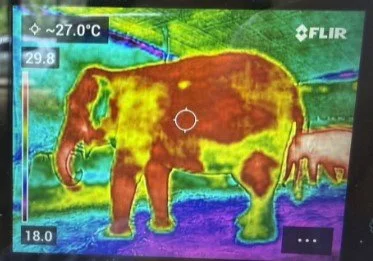
Infrared thermography showed that the swollen area had a higher temperature than the surrounding tissue, suggesting inflammation on the left rear thigh
In addition to the physical lameness cases, there was also a new case of EEHV. A 1-year-3-month-old female elephant calf was reported on February 17, to be lethargic in the afternoon, showing reduced play activity; however, she resumed normal eating and playing behavior in the cooler evening. On February 18, she became mildly lethargic again. Physical examination revealed slight depression but normal appetite, activity, and defecation, with well-formed feces free of soil contamination. Her temperature was 98.7°F, pulse was strong, with no facial edema and no petechial hemorrhages observed in the oral cavity. Vitamin C supplementation was recommended to support immunity, and blood samples were collected for EEHV testing and infection monitoring. Hematology revealed a downward trend in white blood cell and platelet counts, raising concern. The calf was referred to a hospital for further management. PCR testing confirmed infection with Elephant Endotheliotropic Herpesvirus (EEHV). Antiviral therapy was initiated immediately, and a blood transfusion was administered. Follow-up monitoring showed progressive clinical improvement, with platelet counts returning to normal ranges, although viremia persisted in the bloodstream. At last report the calf was still fighting to improve.
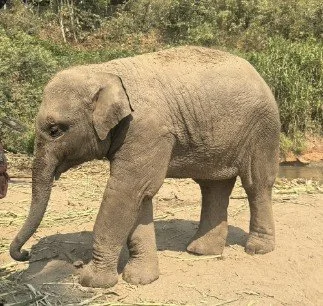
The elephant calf was lethargic, but there was no facial swelling
The professionals of the Chiang Mai University Mobile Vet Clinic continue to provide top notch care for elephants in all states of health. We are so grateful for their efforts to provide care for Thai elephants of all ages! Donate today to support the care of Thai elephants.